Friday, February 25, 2011

Big steps in moving off the grid

Well, this has been a landmark week for my family. We've taken plans that we've talked about for ages and finally just DID them. It's amazing how much relief and security you feel when you stop debating and just take action.


To start the week, we ordered our Big Berkey water filter. We normally use the filter built in to our refridgerator, but that requires an electric pump and needs replaced every 6 months or so. The Berkey can process quite a bit of water, about 7 gallons per hour, and uses gravity to do it's job.
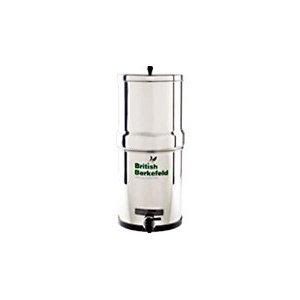
We chose the Big Berkey (http://www.britishberkefeld.com/) specifically for it's reliability, it's stainless steel construction, the availability of parts, and because we couldn't imagine a scenario where we were consistantly providing drinking water for more than 16 people.

The Berkeys use either 2 or 4 Black Berkey filters that are capable of processing 3,000 gallons of mud, or 19,000 gallons of tap water. Since we will be using it to filter tap water (and possibly captured rainwater should the need arise) the 2 filter model was perfect for our needs. The British Berkfields have been around since 1922, so the design is well proven. They also offer the PF-4 filters, which will filter out arsenic and fluoride from water as well.


Sadly, that wasn't the most expensive purchase this week. For the last few years, we have been using the Whisper Mill, a great little electric grain mill that has been easy to maintain. It has done a great job turning our hard red wheat into bread ready wheat flour, and even managed to process amaranth flour.

The Whisper Mill is no longer produced, but has been replaced by the nearly identical Wonder Mill. From what little I've read, there's not a lot of difference between the two, and in the pictures they look nearly identical. As far as electric mills go, the Whisper Mill has a great reputation and for us has proven reliable, even when we enthusiastically had it grind an entire 25 lb bag of wheat into bread flour. It has always worked without complain, and offered only minor criticism when we asked it to process amaranth.


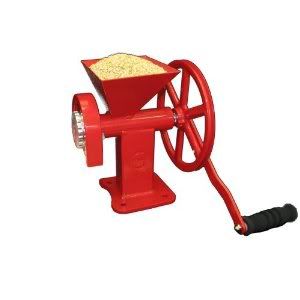
However, as great as the Whisper Mill is, our long term goal is to use a hand-powered grain mill, and started the search for our next mill several months ago. Owning a Diamant was a bit out of our price range, so we looked heavily at the Country Living Grain Mill. The Country Living mill has a good reputation, a significant following, and best of all, a large support network. However, it does have a few downsides. It's aluminum construction, while tough, isn't exactly bulletproof. Parts and accessories are available, but at a premium compared to similar products. And then, while thumbing through Mother Earth News, the answer appeared. There was a full page ad featuring a shiny red mill that looked incredibly sturdy. The Grainmaker (http://www.grainmaker.com/) is also made in Montana, so my dollars are staying somewhat local. It's starting price was higher than the Country Living Mill ($425 vs. $395) but it came with the extension bar and the auger, which would have more than made up the difference. The construction is powder coated steel, and each unit is made and tested individually. There were some complaints on it being difficult to turn online, but there were enough people that used it regularly without incident to bring it to the top of our list. This was a decision that we were hoping to act on in April, but there was a notification on the Grainmaker website that prices are going up in mid-March, so we bit the bullet and ordered it early. In retrospect, I probably should have ordered the clamp (discounted if purchased with your mill) but my longer term plans would make it useless. We are already planning on how many different grains we will try grinding as soon as it arrives. The general rule of thumb is they run a 3 week build time, but that is just time to collect more flax, amaranth, spelt, and anything else we can get our hands on. Once we get the Berkey and Grainmaker in, we'll have to put them together and add reviews.
Thursday, February 24, 2011

The 2011 Garden - Baby steps into Permaculture

As I mentioned in my last post, there has been a significant expansion in our gardening plans for 2011. In 2010, I tore up about 500 sq ft of lawn to convert to garden, this year will see somewhere around 1200 sq ft converted to dedicated garden, and another 1000 sq ft or so converted to a permaculture type garden.


One of our biggest changes from 2009 to 2010 was the addition of raised beds. These went a long ways to reducing the amount of weeding done each week, and for the crops that survived the frost, made a nice home for them. Our total cost for 8 raised beds (2'x4') was absolutely nothing. Many fencing supply companies sell vinyl fencing. The vinyl fencing is sold to them with a 2'x4' pine brace around it. They just slide the braces off and throw them away. Going to a local lumberyard to pick up lumber for the beds, they mentioned that we could have the large stack of braces for free, as well as some trim pieces of cedar and fir left over from fencing projects. It took a few trips with our van, but we manged to get them home and filled with soil. This year, we are adding another 20 beds of the same size, with leftover braces we can build cold frames for the young plants so we do not have a replay of last year.


The selection in the garden is growing as well. Last year, we grew Italian zucchini (Costata Romanesco), some summer squash, and carrots (Tendercrisps) successfully. Just about everything else was killed by the frost. In addition to the Costata Romanesco, we are growing 4 tomato varieties (2 cherry, 1 paste, and 1 beefsteak variety), 3 types of carrots, 4 types of lettuce, celery, amaranth, 4 new squashes, 4 types of melons, 2 types of beans, 2 types of peas, and broccoli. We are also adding blueberry bushes, elderberry bushes, an additional grape vine, and a few new fruit trees. Our experiment with corn last year taught us that if you have a small place to plant, corn is not going to work in your favor. In a different climate, maybe, but our little homestead just didn't agree with our sweet corn crop and we ended up with tiny ears.


For our locale, we will not plant outside until nearly Memorial Day, but once the beds are prepped, I'll have to post some pictures. After all the work going into it, there has to be at least some record of accomplishment.

After a long hiatus...

Wow, I actually forgot that I had this site to maintain. Granted, nobody has ever read it, but all good things have to start somewhere.

Since the last post, there have been some changes, both good and bad, to my long term goals. My garden was tripled in size in 2009 from it's 2008 size. In 2010, it grew again. In 2011, it will be more than double the size of the 2009 garden plot. We have moved from in ground planting to raised beds, which would have done wonders for us if a late frost hadn't killed off most of the 2010 crop. I'll add a new post that covers the detail of the bigger garden plot, the new plant additions, and our lessons learned over the last 2 years.

In other news, we have done our best to reduce our footprint; not just carbon, but also in our impact on the environment immediately around us. We are working towards independence from the energy grid, while still being grid tied, and have made some progress, especially in how we prepare our meals. 2011 is going to see a lot of projects come to fruition, some big, some small. I'll do my best to actually keep track of each project and post what we tried, what we learned, and what we'd do better next time.

Tuesday, March 24, 2009

Spent this last weekend tripling the size of my existing garden. Still not to the size it needs to be, but everything is done in baby steps. The seeds have sprouted, the ground is nearly prepped, just waiting on the weather.

This year we are seeing a lot of new heirloom crops. Roman broccolli, Italian zucchini, black tomatoes, and several varieties of melons and squash. One crop I'm curious to try in our relatively dry soil is Kiwano, a melon native to Africa that should grow decently in this zone.

I'll get pics up in the next day or so, once the weather clears up.

Friday, March 20, 2009

Deciding to Live the Lifestyle

One of the first steps anyone who wants to survive needs to learn is that you can't live the same way you did beforehand. Your reliance on processed foods never seems to be so apparent as when you try and live without them. The single hardest thing for me to give up was the Jack in the Box 2/99 cent tacos.

Depending on the space available, you may not have to alter too much in your eating habits. Since our experiment is only on 0.12 acres, we needed to modify our diet quite a bit to make this work. Thankfully we've gotten into the habit of eating more vegetables and trying to do without a lot of the "luxury" foods. I don't think we've eaten peanut butter in 6 months, which is a pretty amazing feat with 3 young kids. We've gone without buying bread in several months, making a loaf at home should we find ourselves wanting bread. We still need to cut back on our cheese consumption, as our little plot of land does not give us room or zoning for dairy animals. That proves to be a bit tougher than the peanut butter.

By all means, you do not need to become a vegetarian, or start shopping at the organic sections of the grocery store. You just need to re-evaluate what you are willing to do to survive and thrive off the commercial food grid. It's a slow process at this time in history, so take your time, weed out some of the junk and learn to eat a few new things. Buying a vegetarian cookbook is a good way to introduce new homegrowable produce to your family. Try something different from the local farmer's market or butcher shop. Find out what you can eat when the normal foods in your life may not be available, and introduce it slowly into your lifestyle. This way when you are pushed into that more basic lifestyle, you will not experience the shock of a hoarder. Practice makes permanent, so develop your good habits now.

Thursday, March 19, 2009

Beyond the Survivalist

Ever since the Y2K scare, there's been a growing faction in our country. The Survivalist grew out of a view of sudden economic collapse, and started to develop a lifestyle that didn't rely so strongly on the economy. Unfortunately, the movement has gone from self reliance to hoarding food and water with no long term plans.

The portion of survivalists that will actually make it when things get tough aren't the ones with the most food storage or ammo, but the ones that can renew their food supplies and maintain a healthy balance of storage and new sources. Don't get me wrong, having food and water stored is vital for those first few weeks or months, but without a long term plan in action, a hoarder will die shortly after the larder is empty.

We want to encourage you to remove yourself as much as possible from the food supply chain, to become recession/depression/end of the world as we know it proof. There's too many people that have no long term plans for their family's well being, and too many people that rely on a shaky dollar.

This is something that you can do for yourself. All of our experiments and experiences will take place on a 0.18 acre lot with about 0.12 acres in usable space. Others have done this successfully, so will we, but we'd like to save you any trial and error process that we will experience as we go down this route.